






The automotive fuel line system is a critical component of any vehicle, responsible for delivering fuel from the tank to the engine. This system includes various parts such as fuel lines, filters, and pumps, but one of the most crucial elements is the quick connector and its O-ring.
What is a Quick Connector?
Quick connectors are specialized fittings designed to provide a fast and secure connection between sections of the fuel line. These connectors simplify the assembly and disassembly process, making maintenance and repairs much more efficient. They are engineered to maintain a tight seal, preventing fuel leaks and ensuring the safe operation of the vehicle.
Different Standards of Automotive Fuel Line Connectors
| Standard | Description | Typical Applications |
|---|---|---|
| SAE J2044 | Performance requirements for quick connectors used in liquid fuel systems | Fuel lines, vapor lines, cooling systems |
| ISO 7241 | General-purpose quick connector couplings | Fuel lines, hydraulic systems |
| DIN 73378 | Tubing for automotive applications, specifying dimensions and materials | Fuel lines, brake lines |
| USCAR-30 | Performance requirements for fuel system components | Fuel lines, vapor lines |
Requirements for Quick Connector O-Rings
The O-ring in a quick connector must meet several stringent requirements to perform effectively:
- Chemical Resistance: The O-ring must resist degradation caused by continuous exposure to fuel and various additives. This includes resistance to ethanol-blended fuels, which are increasingly common.
- Temperature Tolerance: It must endure the wide range of temperatures found in automotive environments, from extreme cold to high engine temperatures.
- Durability: The O-ring should maintain its integrity over a long lifespan, withstanding the mechanical stresses of repeated connections and disconnections.
- Flexibility and Compression Set: The O-ring must be flexible enough to create an initial seal when the connector is engaged and must resist permanent deformation to maintain the seal over time.
Materials for Fuel Line Quick Connector O-Rings
Selecting the right material for quick connector O-rings is crucial to meeting these requirements. The most commonly used materials include:
- Fluorocarbon Rubber (FKM/Viton): Known for its excellent chemical resistance and high-temperature stability, FKM is a preferred choice for fuel system O-rings. It can withstand prolonged exposure to fuels and oils without degrading.
- Fluorosilicone Rubber (FVMQ): FVMQ combines the chemical resistance of FKM with enhanced low-temperature performance. It is particularly useful in applications where the O-ring must maintain flexibility and sealing properties in extremely cold conditions.
Performance Comparison Between FKM and FVMQ
| Property | FKM (Viton) | FVMQ (Fluorosilicone) |
|---|---|---|
| Temperature Range | -20°C to +180°C | -60°C to +175°C |
| Chemical Resistance | Excellent | Excellent |
| Fuel Resistance | Superior | Superior |
| Low Temperature Flexibility | Moderate | Excellent |
| Compression Set | Low | Moderate |
| Hardness (Shore A) | 60-90 | 50-70 |
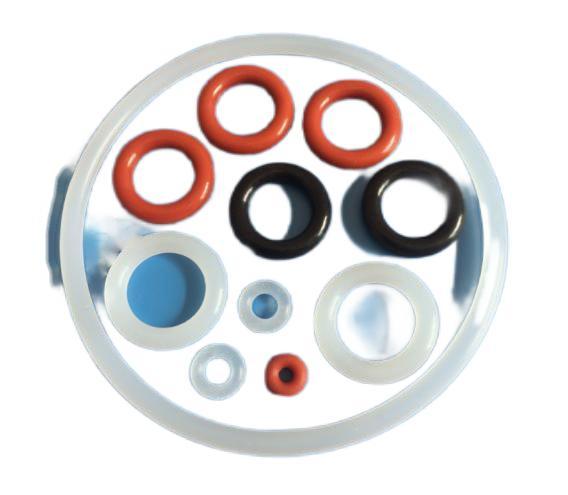
We have in hand exsiting o-rings with FKM and FVMQ for standard SAE connectors as below.
| SAE Standard Size of quick connector | Inner O-RING Size | Outer O-RING Size |
| 7.89 | 7.65*2 | 6X1.5 |
| 9.89 | 9.6*2 | 8X1.5 |
| 9.49 | 9*2 | 8X1.5 |
Thanks to contact us for your sealing requirement on fuel line system application.


