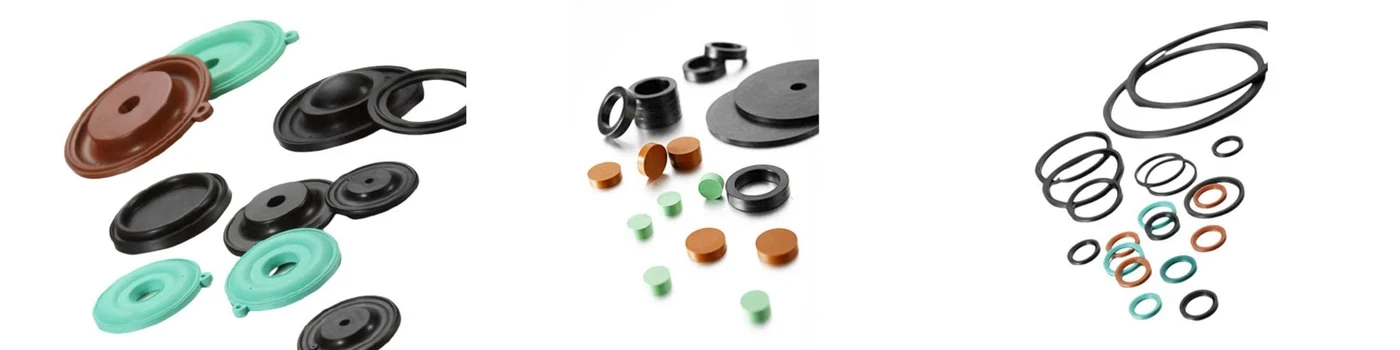


In the petrochemical industry, the requirements for rubber seals typically involve the following aspects:
Chemical Resistance: The liquids and gases used in the petrochemical industry often contain strong chemical components, such as acids, bases, oils, and solvents. Rubber seals need to have excellent chemical resistance to ensure that they do not degrade or fail when in contact with these chemicals. Common rubber materials include fluoroelastomers (FKM) and hydrogenated nitrile rubber (HNBR), which effectively resist various petrochemical products and chemical media.
High and Low-Temperature Resistance: The temperature fluctuations in the petrochemical process can be quite large, so seals must maintain stable sealing performance in both high-temperature (e.g., during the processing of liquid petroleum) and low-temperature (e.g., in refrigeration equipment) environments. Materials such as fluoroelastomers (FKM) and fluorosilicone rubber (FVMQ) offer good high and low-temperature performance.
High-Pressure Resistance: In the extraction, processing, and transfor of petrochemical products, high-pressure and rapid decompression environments are often required. In such cases, Explosive Decompression O-Rings (ED O-Rings) are needed to work under high-pressure gas environments and rapid decompression. The design of these O-rings can prevent decompression damage, which occurs when gas rapidly expands inside the seal, causing blistering, cracking, or delamination failure.
FKM(Fluoroelastomers, Viton®) with 95 Shore A hardness is normally used for ED O-Rings:
| Operating Temperature | -25 °C ~ 200 °C |
| Hardness | 95 Shore A |
| Color | Black |
| Chemical Resistance | Ethane Benzene Natural gas Petroleum Mineral oils Petroleum-based lubricating oils |
Key Applications of ED O-Rings in the Petrochemical Industry:


Oil & Gas Exploration and Production Equipment
1) Subsea production systems
2) Well head systems
3) Christmas trees
4) Drilling equipment
5) High-pressure pipelines and connectors:
These systems operate under extreme high-pressure conditions involving natural gas and crude oil. During emergency shutdowns or blowout prevention operations, rapid decompression may occur, and ED O-Rings help prevent seal failure under such conditions.
Gas Compressors and Boosting Equipment
1) Natural gas booster station
2) Hydrogen compressor
3) CO₂ compression system
These machines compress gases to extremely high pressures. When they are shut down or undergo process adjustments, rapid decompression may occur, requiring ED O-Rings to prevent damage and leakage.
High-Pressure Gas Storage and Transportation
1) LNG (Liquefied Natural Gas) storage tanks and transport systems
2) Hydrogen storage tanksHigh-pressure CNG (Compressed Natural Gas) storage systems
3) Carbon Capture and Storage (CCS) systems
These applications involve storing gases at high pressures, and during usage or transportation, rapid pressure drops can occur. ED O-Rings help maintain sealing integrity under these conditions.
High-Pressure Reactors and Processing Equipment in Petrochemical Plants
1) High-pressure chemical reactors
2) Gas separation units
3) Supercritical fluid processing systems
These units often handle high-pressure or supercritical gases (e.g., supercritical CO₂ extraction). When rapid decompression happens, standard O-rings may fail, while ED O-Rings provide enhanced reliability.
Pressure Relief Valves and Emergency Blowdown Systems
In petrochemical plants and refineries, safety relief systems release high-pressure gases during emergencies. The valves used in these systems must withstand sudden pressure drops, making ED O-Rings essential to prevent sealing failure.
Please contact us, OBT Rubber Seal, for better understanding your technical requirement and our proposal regarding rubber seals for petrochemical industries.


