

When the high-power ASIC chips(such as cryptocurrency mining, video processing, or AI computations) are working, electrical energy is not only used to drive transistors for logical operations, but also a portion of the energy is inevitably converted into heat. This is because electrons collide with transistors when passing through them, generating heat.

Power devices include diodes, transistors, and thyristors, with transistors including MOSFETs (Metal Oxide Semiconductor Field Effect Transistors) and IGBTs (Insulated Gate Bipolar Transistors).

When a MOS or IGBT transistor is conducting, there is a certain resistance in its channel, called the conducting resistance (RDS (ON)). When current passes through, this resistor generates Joule heating, causing the MOS transistor to heat up.
To ensure the stable operation of the chip, heat dissipation design is crucial. Current mainstream liquid cooling technologies, mainly including the following:
1. Single phase liquid cooling technology

Working principle: This technology uses a single phase (liquid) coolant to circulate inside the system, absorbing and removing heat through convective heat transfer. The temperature of the coolant increases after absorbing heat, but it remains liquid and does not undergo a phase change.

Application scenarios: Single phase liquid cooling technology is widely used in the fields of data center server cooling, automotive engine cooling, and industrial equipment cooling. For example, in data centers, this technology can quickly dissipate the heat generated by servers, ensuring their stable operation.

Advantages: Simple system structure, stable and reliable operation, low maintenance cost; The flow rate and temperature of the coolant are easy to regulate and can be precisely adjusted according to different heat dissipation requirements; Good compatibility with devices and suitable for various types of heating equipment.

Disadvantages: The heat dissipation efficiency is relatively limited, which may not meet the heat dissipation requirements in high heat flux density scenarios; The performance indicators of the coolant, such as specific heat capacity and thermal conductivity, have a significant impact on the heat dissipation effect, and it is necessary to choose a suitable coolant.
2、 Two phase liquid cooling technology

Working principle: This technology is based on the gas-liquid two-phase change of the coolant in the system to achieve efficient heat dissipation. After absorbing heat, the coolant partially evaporates into steam, which transfers heat to components such as the condenser through flow and condenses into liquid in the condenser. It is then recycled back to the vicinity of the heat source to continue absorbing heat and evaporating, forming a cycle.

Application scenarios: Two phase liquid cooling technology is commonly used for heat dissipation of high-power density electronic devices, such as supercomputers, high-performance graphics cards, etc. It is also applied to military equipment and aerospace equipment that require extremely high heat dissipation.

3. Advantages: Extremely high heat dissipation efficiency, capable of transferring a large amount of heat in a small volume and mass; Accurate temperature control allows the system to operate stably within a narrow temperature range.

4. Disadvantages: The system structure is complex and requires specialized components such as condensers, evaporators, and gas-liquid separators, which increases costs and volume; The sealing requirements for the system are extremely high. Once a leak occurs, it will seriously affect the heat dissipation effect and may lead to equipment damage; During operation, precise control of the ratio and flow state of gas-liquid phases is required, making it difficult to control.
3、 Immersion liquid cooling technology

Working principle: This technology completely immerses the heating equipment in the cooling liquid, and heat is directly transferred from the heating components to the surrounding cooling liquid. The cooling liquid takes away the heat through natural convection or forced convection. Some technologies also utilize the boiling phase transition of the coolant to enhance heat dissipation.

Application scenarios: Immersion liquid cooling technology is gradually increasing in the field of data centers, especially suitable for high-density deployed server clusters; It is also applicable to scenarios with high requirements for heat dissipation and limited space, such as edge computing nodes, on-board electronic devices, etc.

Advantages: High heat dissipation efficiency, able to directly remove heat from the heat source; Can achieve high-density deployment of devices and save space; The coolant has electrical insulation properties, which improves the safety of the system.

Disadvantages: High performance requirements for the coolant, including good thermal conductivity, electrical insulation, chemical stability, and low boiling point; Equipment maintenance is relatively difficult, and during repairs, it is necessary to remove the equipment from the coolant, which may result in coolant leakage and waste; The high cost of technology limits its large-scale application.
4、 Microchannel liquid cooling technology

Working principle: This technology processes small-sized channels on the surface of heat sinks or equipment to allow the coolant to flow in microchannels. By increasing the heat dissipation area and improving the contact efficiency between the coolant and the heating surface, the heat dissipation effect can be enhanced.

Application scenarios: Microchannel liquid cooling technology is widely used in miniaturized, high-performance electronic devices such as smartphones, tablets, laptops, etc; It is also suitable for industrial microprocessors and sensors that require high heat dissipation.

Advantages: It can achieve efficient heat dissipation in limited space, meeting the needs of device miniaturization and high performance; Microchannel design can increase the flow rate of coolant and reduce pump power consumption; Can be combined with other heat dissipation technologies to further enhance heat dissipation performance.

Disadvantages: Microchannels require high processing accuracy and high manufacturing costs; The channel size is small, which is prone to problems such as blockage and scaling; The cleanliness requirements for the coolant are high, and it is necessary to equip it with a fine filtering device.
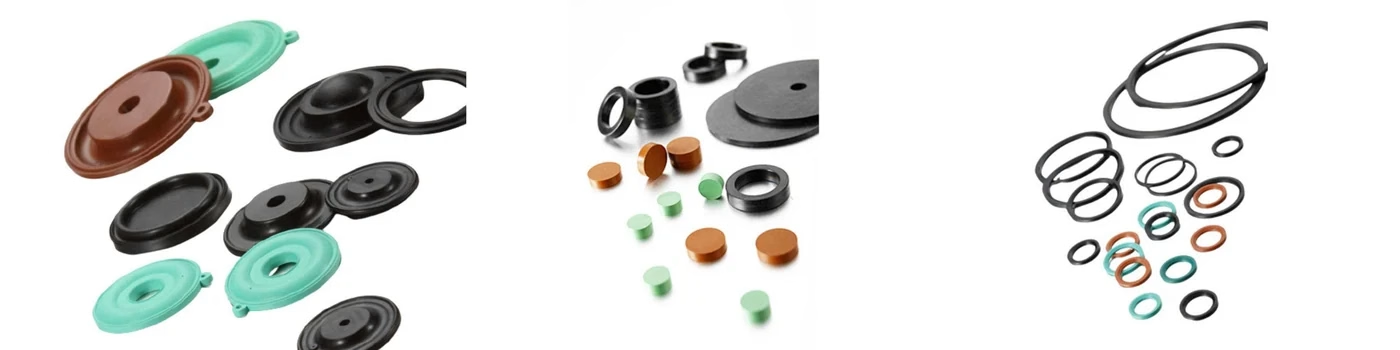
Rubber seals in liquid cooling systems require excellent chemical resistance, low-temperature flexibility, and long-term durability under continuous operation. OBT offers customized sealing solutions with rubber materials(such as EPDM) optimized for resistance to coolants,refrigerant and thermal stability.


