
| Custom Rubber Products Manufacture |
| Home—-About Us —- Information —- Products —-Contact Us |
O Ring/X Ring(Quad Ring)/Y Ring

We are custom O Ring manufacture in China with quick tooling development and competitive cost. Various material with different hardness are available for different application:
FKM(Viton O Ring), HNBR , Silicon(Silikon) , Teflon (PTFE),FVMQ , EPDM , FFKM ,Neoprene, PPS, PEEK.
How to choose O Ring, X Ring(Quad Ring), Y Ring?
Compare to O Ring, X Ring(Quad Ring) and Y Ring can offer:
– better sealing performance due to multiple sealing surfaces
– lower friction and less wear
– suitable for dynamic sealing applications
When choosing between O-rings, X-rings, and Y-rings, consider factors such as pressure, temperature, speed, media compatibility, groove dimensions, and sealing requirements of your specific application.
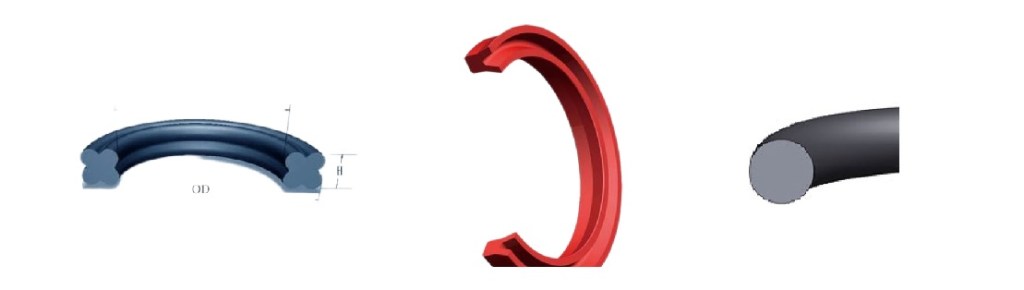
| Seal design | Typical Applications | Advantages |
| O-Ring | Static sealing mainly | wide rang of exsiting size cost-effective |
| X-Ring (Quad Ring) | Dynamic sealing (rotary and linear movement) | Four sealing surfaces provide better sealing Less friction and wear than O-Rings |
| Y-Ring | Static and Dynamic sealing | High over-compression tolerance Low friction Shock absorbers |
Please contact OBT to ensure you select the most suitable sealing solution for your needs.
Typical Application For O-Rings
Our EPDM O Ring has good compatibility with refrigerants and POE/POG oil, and can replace HNBR materials to meet the requirements of this application.
Our HNBR  O Ring can have good compatibility with R32 or R290.
- Cooling system
Our EPDM O Ring has good compatibility with coolant water, could work under low temperature -50℃.
- Fuel line system
Our FKM Viton O Ring and FVMQ O Ring is available to work Work for a long time in gasoline, diesel and exhaust gas environments.
We have existing size O-RING for standard VDA and NW quick connector. Typical coating like FP coating can be applied onto the surface of the O-Ring for less assembly force.
- Engine EGR
The EGR (exhaust gas recirculation) system operates at a high temperature of 200°C, and the gas contains corrosive oil and gas mixtures, which places high demands on rubber seals such as O-RING. Our FKM materials can withstand the working conditions of EGR.
How to design an O Ring?
1.O Ring Material Selection

In some application, coating is required to be applied on the surface of the o ring for :
- less friction
- less assembly force
- chemical resistance
We OBT could offer different types of coatings available, including PTFE and PF coatings.
| Rubber Material | Temperature Range | Chemical Resistance | Abrasion Resistance | Compression Set | Flexibility | Cost |
| Nitrile (NBR) | -40°C to +120°C | Good | Good | Good | Good | Moderate |
| HNBR (Hydrogenated Nitrile) | -30°C to +150°C | Excellent | Excellent | Excellent | Good | High |
| Silicone (VMQ) | -60°C to +230°C | Fair | Fair | Fair | Excellent | Moderate |
| EPDM(Ethylene Propylene Diene Monomer) | -50°C to +150°C | Good | Good | Good | Good | Moderate |
| Fluorocarbon (FKM/Viton) | -20°C to +200°C | Excellent | Excellent | Excellent | Poor | High |
| FVMQ (Fluorosilicone) | -60°C to +225°C | Excellent | Fair | Good | Excellent | High |
| AEM (Ethylene Acrylic) | -40°C to +150°C | Excellent | Fair | Good | Good | High |
| ACM (Polyacrylate) | -25°C to +150°C | Good | Good | Good | Good | Moderate |
| Neoprene | -40°C to +120°C | Good | Excellent | Good | Good | Moderate |
| FFKM (Perfluoroelastomer) | -20°C to +325°C | Excellent | Excellent | Excellent | Poor | Very High |
2. Calculate O-Ring Dimensions
| Inner Diameter (ID) | Standard Tolerance: ±0.13 mm (±0.005 inches) |
| Tighter Tolerance: ±0.08 mm (±0.003 inches) for precision applications or custom requirements | |
| Outer Diameter (OD) | Standard Tolerance: ±0.13 mm (±0.005 inches) |
| Tighter Tolerance: ±0.08 mm (±0.003 inches) for precision applications or custom requirements | |
| Cross-sectional Diameter (CS) | Standard Tolerance: ±0.20 mm (±0.008 inches) |
| Tighter Tolerance: ±0.13 mm (±0.005 inches) for precision applications or custom requirements |
3. Define the interference between the groove and the O-ring
1)Static Sealing Applications:
For static sealing applications, such as gasket or flange sealing, the interference fit is typically in the range of 10% to 30% of the O-ring’s cross-sectional diameter.
For example, if the O-ring’s cross-sectional diameter (CS) is 5 mm, the interference fit may range from 0.5 mm to 1.5 mm.
2)Dynamic Sealing Applications:
- In dynamic sealing applications, such as reciprocating or rotary motion seals, the interference fit is usually lower to minimize friction and wear.
- The interference fit for dynamic seals is typically in the range of 5% to 15% of the O-ring’s cross-sectional diameter.
- For example, if the O-ring’s cross-sectional diameter (CS) is 5 mm, the interference fit may range from 0.25 mm to 0.75 mm.
3)Material Considerations:
- Softer O-ring materials, such as silicone or EPDM, may require less interference to achieve proper sealing compared to harder materials like fluorocarbon (FKM) or nitrile (NBR).
- The groove should be designed to provide sufficient compression on the O-ring without causing excessive deformation or stress.
4)Temperature and Environmental Conditions:
- High temperatures may cause thermal expansion of the O-ring and the groove, affecting the interference fit.
- Chemical exposure, pressure fluctuations, and other environmental factors should also be considered when determining the interference fit.
Свяжитесь с нами
Suzhou Obtiv Technology Co.,LTD
No.211 Zhujiang Road, Suzhou City, China
Wechat: 
Email: tom@rubberproducer.com